In his presentation to the 2025 Annual Meeting, Chris recalled that TMAEG had begun in 2011 as a campaign to save our central feature, our twin avenue of glorious silver maples.
From a Campaign to Save Trees….
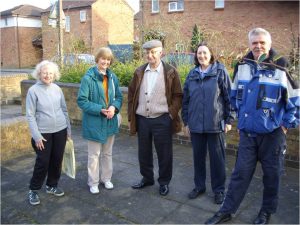
Principal design features of Two Mile Ash, they had recently been earmarked for felling, in an ill-thought-out scheme to make way for more car parking. That six-month, community-led ‘battle for the environment’ had been won, and the trees remain. TMAEG was formally launched on Saturday 8th October 2011 at a public meeting held in Holy Cross Church. It was to become a highly successful, multi-purpose environmental body run entirely by volunteers. Notable ingredients to our success have been:
- An ambitious environmental programme – to be guided by a strategic plan – the Environmental Projects Plan.
- Education – Working with Ashbrook School, combining an educational role in terms of bulb planting, with the enhancement of the school’s frontages.
- Partnerships – working with other bodies to magnify the impacts of what TMAEG’s teams can achieve on their own.
- Biodiversity – broadening the diversity of wildlife (plant and animal life) across Two Mile Ash.
- Open Gardens – fostering an interest in gardening through ten years of Open Gardens.
- Well-being – through bringing residents, businesses and institutions together, and getting to know each other better through working in teams, and through visits and social events.
An ambitious environmental programme
Fourteen years, now into fifteen, of largely Saturday morning projects, with volunteer teams six to 15 strong, have significantly improved the Two Mile Ash environment. They have been concentrated in landscape corridors and other important pedestrian areas and bring together new projects and the sensitive management of what is already there. The Ashbrook Corridor is a prime example of such a landscape corridor. Under the 2013 national ‘Big Tree Plan’, 50 new trees were established.
Ken, Lydia and Peter – a job well done!
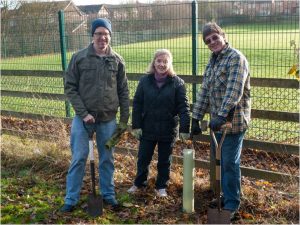
There have been some smaller projects too, aimed at the enhancement of very local areas. The planting of a cherry tree in a ‘landscape island’ in Denmead is one example.
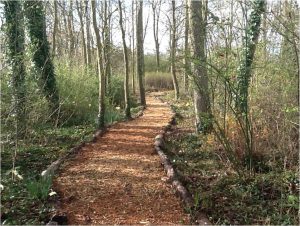
The presentation singled out three other projects. First, the Milesmere/Thorncliffe path and woodland area where, early in the life of TMAEG, an existing track was replaced by an all-weather log and chippings path. On either side, glades were created to let in light, and accommodate wild daffodils, anemones and other wildflower bulbs. Particularly beautiful in the spring and early summer, this track connects the housing of Milesmere and Thorncliffe to a green path on the edge of Two Mile Ash and was to become part of today’s Bluebell Circuit.
An existing path newly surfaced by TMAEG
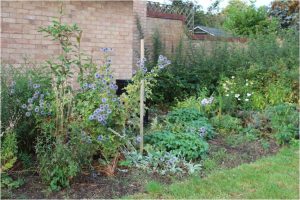
The second focus was the Twin Gardens strip which connects The High Street in the village centre with the Local Park. Striking floral displays at the High Street end ‘morph’ to residents’ gardens and then, at the Local Park edge, two mirror image gardens dominated by colourful shrubs and perennials. Completing these gardens and maintaining them for the long term has been a sizeable commitment for TMAEG.
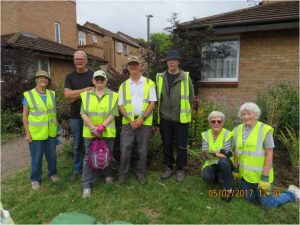
Twin Gardens – work done one Saturday morning 20 July 2024
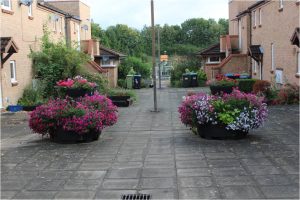
Twin Planters area – a very popular display
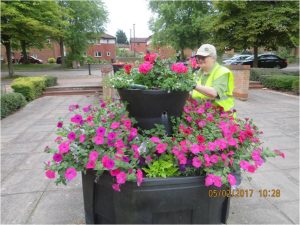
Twin Gardens – at other end working on Phase 2 gardens
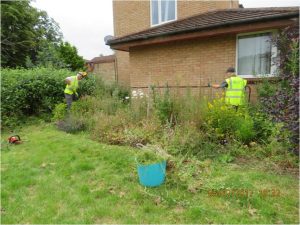
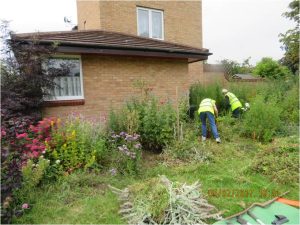
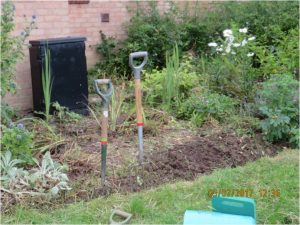
After Pictures of the two sides
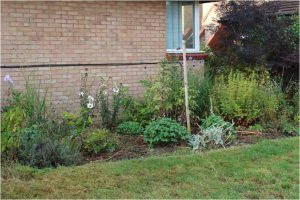
Almost three hours of work Including a coffee break!
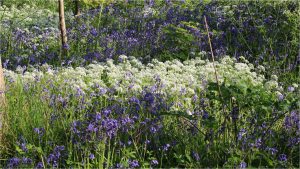
The same applies to our third project, the Bluebell Circuit, which was formally launched by TMAEG in April 2022. After an intensive period of planning, design and construction we now have a popular 750m walking circuit passing through two very different woodlands, and connected by a ’green ride’ following the line of Watling Steet as well as residential streets and footpaths. Its construction highlight is an 11m-long steel and timber bridge designed and specified by TMAEG in conjunction with the landowner Milton Keynes Parks Trust. This spans a deep brook that passes under the road from Whitehouse.
Bluebell Circuit – the latest part of our Environmental Projects Plan
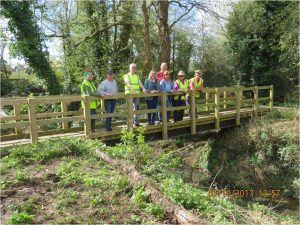
With the winding paths that connect to it, we have revealed a largely hidden feature (and treat!) of Two Mile Ash, its bluebell wood. We encourage all to visit at Bluebell Time but there is also plenty to see at other times of the year, particularly in September/ October to view the emerging autumn colours.
https://www.tmaeg.org/bluebell-circuit/
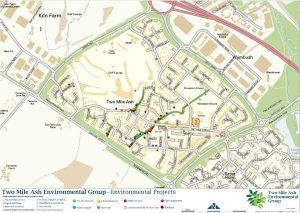
The Environmental Projects Plan, last updated in 2016, is our guide. It shows the environmental corridors and other areas in which we work. It is in need of updating to show the connected-up Bluebell Circuit and our area of work in the Central Gardens where we support the work of the Community Garden Group.
Environmental Projects Plan 2015
Education Work
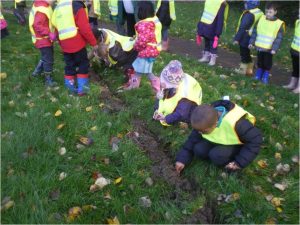
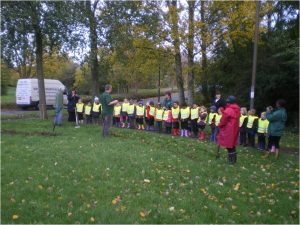
For a period of ten years until the onset of Covid, TMAEG worked with Ashbrook School to give each child joining the school the opportunity to plant daffodil bulbs; MKCC officers helped in the early years. The areas chosen were largely on the opposite, northern side of The High Street, within the entrance to the Local Park. Others were planted in the green to the south, along the pathway leading to Stone Hill.
Around sixty entry-level children, divided into two groups, were involved each year. These groups were shepherded to the site by their teachers and given a lively talk from Pavla (mainly) about the task ahead and what they could expect to see of their ‘February Gold Treasure’ in roughly four months’ time. They were then taken in smaller groups to the planting areas where our volunteers had pre-dug rows of turf. The children then planted their three bulbs in the exposed soil and finally the lifted turfs were replaced.
This ‘ceremony’ lasted about an hour, an experience that our young participants will long remember. Taken over those ten years, around two thousand bulbs were planted and the collective result each spring is much admired.
EDUCATION – Ashbrook School bulb planting with Year One children
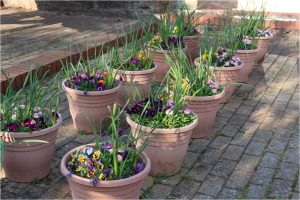
While bulb planting with the children has ceased for now, we continue to work with the school in respect of physical enhancement; the twelve tubs at the front of the school have been our long-term commitment to this. They are re-planted by our volunteers twice a year, the school paying an annual fee. The two plantings match the mixes used in the big planters in the Twin Gardens area. More work is planned around the perimeter of the school in 2027.
Partnerships
This scheme at Ashbrook School is one of an increasing number of projects where TMAEG has joined up with institutions, other community organisations and businesses. Such partnerships have magnified our impact far beyond what we could achieve entirely on our own. In several of the bigger cases, projects would not have happened without the close involvement of other parties from the start.
Over the last couple of years our gardening has returned to the Central Gardens between the two schools where we began. The saved maple trees have flourished and the spaces beneath them have been re-planted, initially by MKCC and, more recently, the Community Garden Group (led first by High Street resident Janice Cristoe, and, with her passing, by her husband, Ray). This is a big area and through periodic joint working with TMAEG it has been possible to keep the gardens at their tidiest and as a choice sitting out area for the summer. The photos show our joint team enjoying a break, and spring views of our garden areas further enhanced for 2025 through the planting of 500 colourful tulip bulbs. We thank Abbey Hill Community Council for these.
A productive partnership
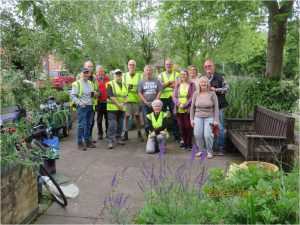
The Community Garden – Spring 2025 – joint tulip planting with bulbs supplied by the Community Council
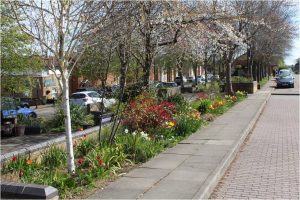
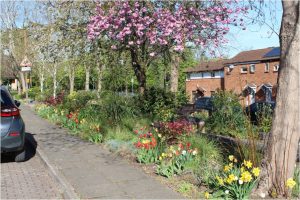
Other partnerships apply to the Twin Gardens which link the High Street to the Local Park. The two businesses (Two Mile Ash Dental Practice and the former hairdressers known as Hair Culture} own the large hexagonal planters on the slabbed area between them. While TMAEG is largely responsible for the design and management of their decorative seasonal planting, the overall costs are shared between the parties. The businesses are responsible for their own frontage gardens and the summer watering of their planters.
Editors Update – Hair Culture closed in early May 2026 after some 37 years of service. It has already been converted back to its former use as a flat . Preliminary discussions between the proprietors and TMAEG indicate that the former would wish to retain their interest in the planter and for the time being at least continue with their present partnership with TMAEG and with the dentists. Among other considerations, that would be subject to the costs involved in this time of rising prices
The present pair of identical planters at the entrance to the Local Park has been of great environmental benefit to this central part of TMA, It is to be strongly hoped that through our negotiations and the involvement of other bodies we will be able to secure a continuation of the present partnership.
Much of the land making up the Bluebell Circuit involved land under the control of Milton Keynes Parks Trust (MKPT) and its realisation required a close working relationship with them. The most challenging decision was the choice of how to connect the circuit across the deeply set brook originating in what is now Whitehouse. The answer that TMAEG reached was a footbridge level with the stream banks and that this would need to be 11m (35 ft) long. But where exactly would it cross and how would it protect important trees such as the multi-stemmed hazel that is so distinctive on the eastern bank of the stream?
The Bluebell Circuit Bridge foundations – the first steps
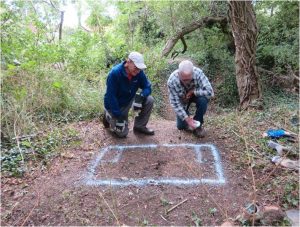
Fortunately TMAEG had ‘in house’ many of the skills that would be required from planning and tree knowledge, to laser surveying, to design and to working with concrete. Also, we learned others’ skills, notably Method Statements from the Parks Trust, and how to cope with the requirements of the drainage authorities.
But we also needed partners to prepare formal plans for planning permission and David Lock and Associates very generously ‘lent us’ a member of their team to draw up the overall plans. In parallel, TMAEG completed the detailed bridge design in conjunction with MKPT, and in consultation with the planning authority Milton Keynes City Council. We also approached Milton Keynes Community Foundation to seek grant aid. So, everything came together in the end, leading to the positioning of the foundations by TMAEG and the setting down of the deck on those foundations (MKPT) and the path connections (TMAEG and others). All this happened at Bluebell Time !
The Bluebell Circuit – Bluebell Time
In terms of partners, there were eight of us in total. Beyond the five mentioned already, the other three were: Abbey Hill Parish Council (remainder of funding); MK Green Gym (sections of the path); Brioche Pasquier (brioches and other catering for the launch)
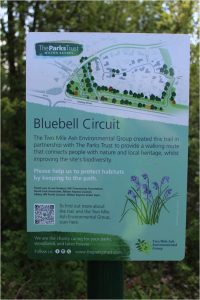
Metal based signs provided by the Parks Trust
Biodiversity
TMAEG seeks to improve biodiversity across Two Mile Ash. One of the simplest definitions is that set out in the Oxford Dictionary of English: The variety of plant and animal life in the world or in a particular habitat, a high level of which is usually considered to be important and desirable.
But how do we spot improving biodiversity in the Two Mile Ash grid square? One answer lies in some of our work. Close to the start of TMAEG our volunteers took part in a national tree planting scheme, our share being 50 whips in five species. These were planted mainly along the valley of the Ash Brook, a designated TMAEG corridor. Other trees were planted in successive years.
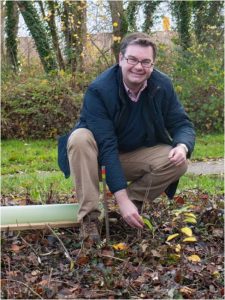
MP Iain Stewart planting an English Oak
Most of those trees have flourished and a couple of species which were not present before are now doing particularly well – these are hornbeam and walnut. At the opposite end of the scale, our volunteers are to be congratulated for planting English primroses along the stream banks, these being very striking when seen from the High Street bridge. In these two respects, that we have more tree types and more trees in total than before (meaning before TMAEG), and that we have an abundance of English primroses along the stream bank, this Local Park section of the stream habitat could be said to be more diverse .
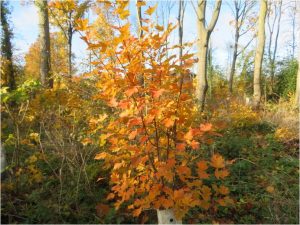
As a more recent example, our bridge and paths in the Bluebell Circuit have been complemented by the planting of some 65 trees in eight different species. In early 2026, 25 more hazels were planted, also gifted to us by the Parks Trust, and they have two main objectives. The first is to diversify the plantation mix away from an over-dependence on Norway maples, together with ash, with its vulnerability to die-back. The second objective is to expand the ‘ecological depth’ of the wood by creating a middle canopy layer. The trees being planted by TMAEG are certainly diversifying the mix. However, the second objective is longer term, and it will be some time before this new more biodiverse habitat emerges, providing, in particular, a more accommodating place for bird life.
Bluebell Circuit – the TMAEG trees
Wild Service Tree- Sorbus torminalis Wayfaring Tree – Viburnum lantana
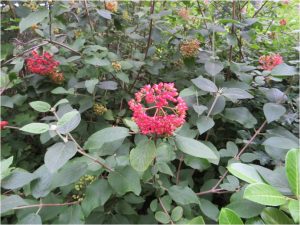
Elsewhere within the Bluebell Circuit we have sought to diversify the ground layer by planting native English primroses, wood anemones and wild daffodils in the Milesmere/Thorncliffe woodland as well as a range of meadow species in the large wildflower area to the south of the bridge crossing.
Open Gardens
From the outset, TMAEG realised that while the wider environment of Two Mile Ash was an important cause, so were people’s private gardens. There was a hunger for ideas about garden layout and suitable plants, and how to make gardens special. So, in July 2013 we ran a single day Open Gardens ‘to test the market’ and to provide some of those ideas. The trial certainly caught on and we began Saturday/Sunday events from the following year, with follow-ups in 2016 and 2018. The striking ‘yellow passport ‘, the entry ticket to the gardens, became very familiar and attendances got better every year.
Open Gardens 2018 an invitation to potential gardeners.


Because of Covid we were obliged to abandon the planned 2020 event; instead we held a virtual Open Gardens with professionally taken photos in the place of garden visits. Open Gardens returned in 2022 and attracted a record number of visitors, with more than ever from outside our boundaries. But it was the final one for now.
Why was that, given the popularity of Open Gardens? One was that the team was struggling to find gardeners to join the entries because so many of the obvious candidates had already exhibited. So the decision was to ‘rest’ Open Gardens for a few years to allow new people to settle in Two Mile Ash and come forward to exhibit with fresh gardening ideas. The Committee resolved to leave a full archive on the TMAEG website including many photos and a fuller Open Gardens story – https://www.tmaeg.org/open-gardens/
We look forward to a revival of Open Gardens in just a few years with a fresh team to run it. When you think you are ready, do let us know!
Well-Being
At their best our environmental projects foster a sense of real satisfaction amongst our members. Our projects provide valuable physical exercise, new skills can be picked up, and there is often close contact with nature. In addition, team working provides an extra dimension, so often enabling a task that seems daunting at the start to be comfortably completed by the end of the session. Also, the friendships that often develop through our coffee and tea breaks can be so enriching to participants.
TMAEG has always been as much social as environmental.
While we would encourage potential members to try out our projects, that isn’t always possible, for health reasons perhaps. So we aim to boost the numbers of people we attract through other TMAEG activities. There are generally about four or five of these through the Year: they range from quite distant places like the Coton Manor Gardens in Northants to Parks Trust events like visits to the Flood Plain Forest Park and Linford Manor Park, industries like Brioche Pasquier and the recycling centres, to historical centres such as Bradwell Abbey and the Roman Villa. Looking to the housing of the future, we’ve had two guided walks around the Whitehouse Grid Square.
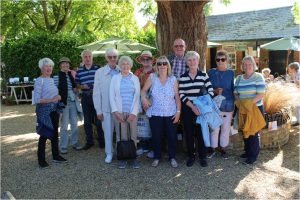
Coton Manor Garden – ‘the end of a lovely day’
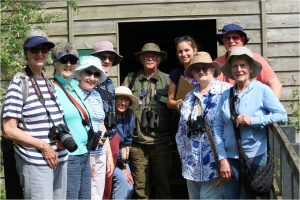
Flood Plains Forest Park – Bird Hide
On other occasions we have invited outside speakers to address us on gardening, through a Gardeners’ Question Time, and an evening on energy saving in our homes.
We have also met Stony Stratford’s volunteers who gave us a PowerPoint presentation of their amazing gardening work and followed this up with a walking tour of their sparkling achievements.
We should not forget that our biggest event of the year is the TMAEG Annual Meeting and that is a social event in its own right, particularly the tea and cakes so carefully put together by Margaret and her team with extra contributions from our membership. Thank you.
A request: Do let us know if you have any more ideas for visits/activities that we might do over the coming year or beyond.